
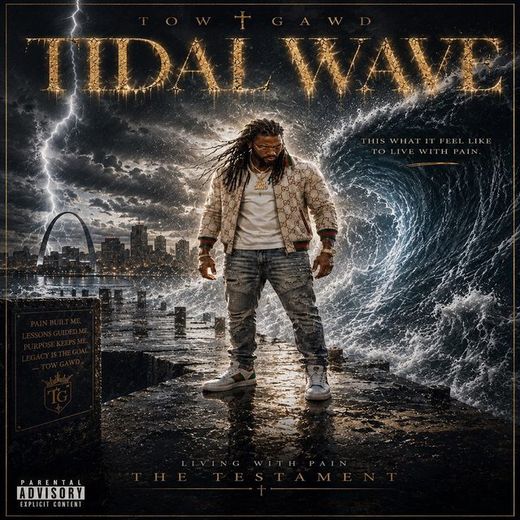
Tow Gawd · Street Gospel
Tidal Wave
The villain in a story where he paid for everything
- Provider Pressure
- Unreciprocated Care
- Self-Medication
- Resentment
- Isolation
Spoken, low, over F# minor: this is what it feels like when you made everybody's life easy and somehow you are still the villain. The record spends four minutes proving that sentence. He made it, and the making is documented — top steakhouses instead of corner sales, a bank account that stays crowded, white Bordeaux instead of what he used to sip. But every luxury is paired with a bill. Shingles on his face.
Eyes that finally see clearly at the exact moment some things become invisible. Three rebuilds. A liminal phase. The mechanic is the collapse of gratitude as a transaction — he keeps unpacking someone's life and keeps being the problem afterward. Verse two is unsparing about the woman he lifted: she came from bags in a basement, she stopped answering her mother's calls, she has no complaints and is still mad, and he can spot the fake laugh because he paid for the trip that was supposed to produce a real one.
The most honest line in it is a diagnosis of himself — he thought he was an alcoholic and was self-medicating. What it cost was his health and his sense of being seen. What came after is a man imagining the pier, and saying he is not ashamed.
Man, I thought I was an alcoholic, whole time I was self-medicating pain
The sound
F# minor over Dsus, A and E through the verses, the hook dropping to Em7 and Em9 under a strained chest tenor, half-time bridge holding F# minor tension, dark luxury R&B with a gospel lean.
The story behind it
"Tidal Wave" is the evolution of "Live With Pain" and the title the visual world was built under. Its documented story: the narrator is searching for escape from turbulence that follows him at every life stage, and the pressure of each phase is slowly eroding his sense of self. The tidal wave is the neutralizer that washes the eroded self away. Standing on the Eads Bridge with the tide risen almost to the deck, he realizes he no longer fears his demise, jumps into the wave as surrender and rebirth rather than despair, and emerges on the other side in a baptism pool.
Water changes from threat to rebirth rather than being spectacle.
The visual world
A 119-scene ATLabs film in five chapters: a Color Purple-inspired church opening (black grand piano, choir procession, the artist as choir director walking the aisle), a working-class trauma walk past childhood, street, court, work, family, business-rebuild and police-harassment memories while plumbers, construction workers, bricklayers, mechanics, nurses and prisoners join the procession, a flood plunge, recovery through running, calisthenics, boxing and physical therapy, and an Eads Bridge reconstruction finale where a battered lead holds the bridge up while people cross.
A Plush Tow rotator recovering a car driven off a cliff ties the flood metaphor to the towing identity. White linen, iced TOW GAWD pendant, all-Black cast, no captions; delivered as a 6:43 2K widescreen master plus a vertical cut.
Plays with
Later evolution of "Live With Pain"; also exists as a separate "Tidal Wave ft The Dispatchers" version.