
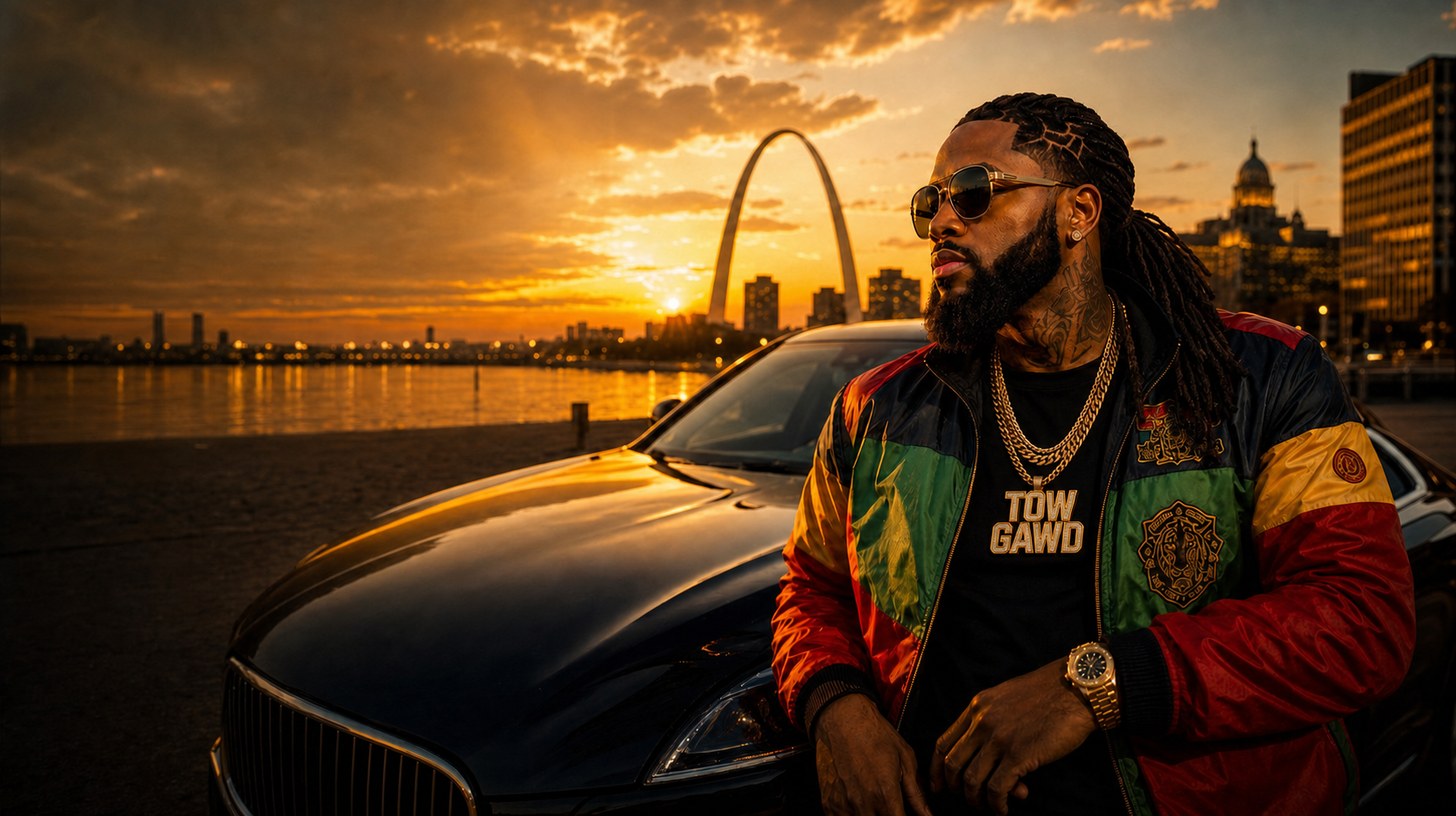

Washington Avenue, before the internet decided what you liked
It starts in a record store. Streetside Records on Washington Avenue, downtown St. Louis, a kid walking in with his father — buying cassettes, buying Johnnie Taylor CDs, back when a disc you wanted badly enough had to be ordered out of a catalog and waited on for weeks.
That wait matters. It is the difference between consuming music and choosing it. You had to know what you wanted before you could have it, and then you had to sit with it — one album, played until the tape wore thin, because there was no next thing one thumb-swipe away. That is where the ear got built.
The foundations he still names are the ones from that shelf: Songs in the Key of Life, TP-2.com, Thriller. Not nostalgia picks — working blueprints. Records where the melody carried the message, where the arrangement did emotional labor, where somebody clearly decided that a song should be built rather than uploaded. That era taught him melody, songwriting and soul — how to make a record a person feels instead of merely hears.
Going to Streetside Records on Washington Avenue with my dad, buying cassettes and Johnnie Taylor CDs back when you had to order discs out of a catalog and wait for them to ship. That's where my love for music started.
Two jobs, one name
Most artists have a day job they would rather you not ask about. His is the name on the record.
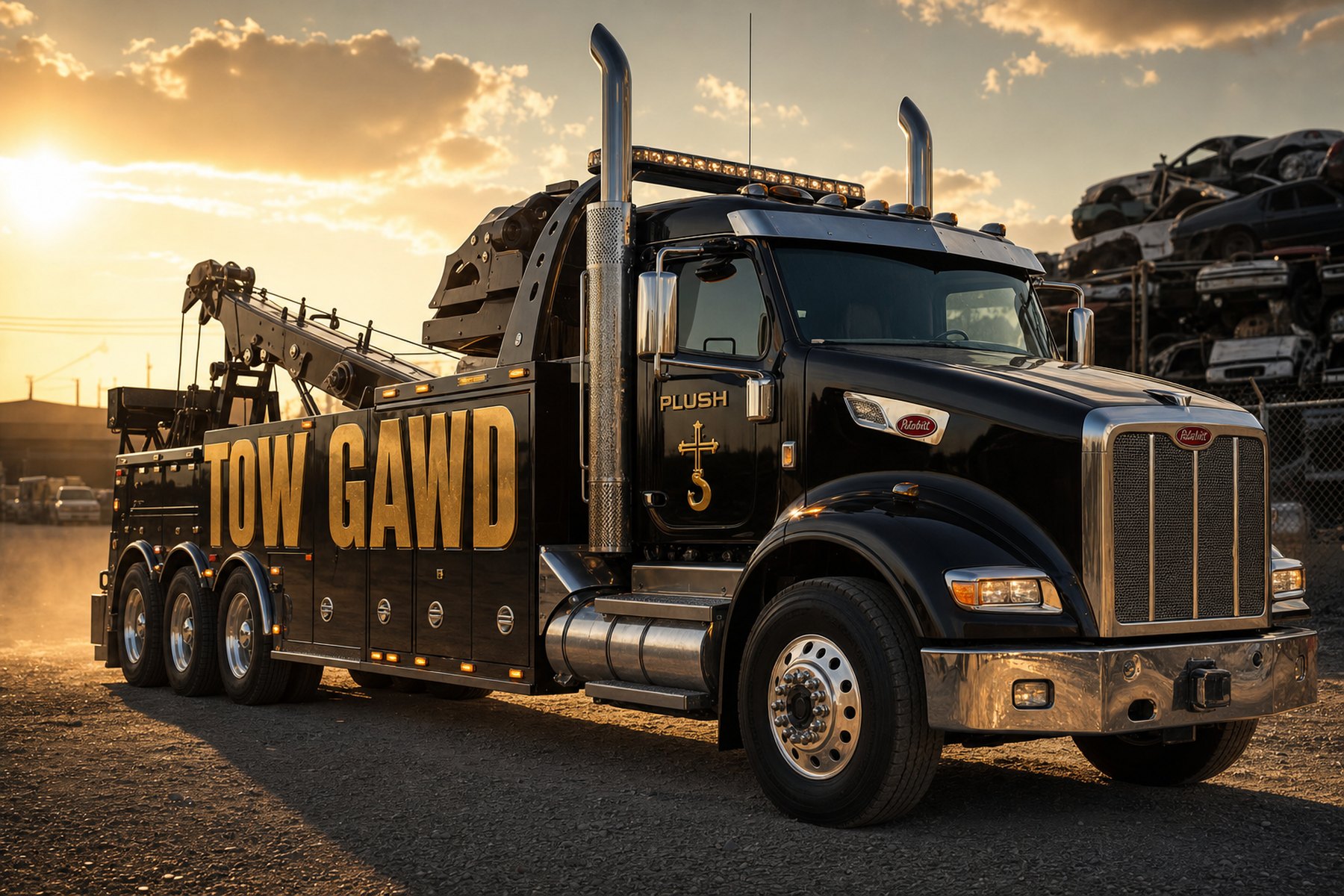
Tow Gawd runs a towing and transport operation out of St. Louis — recovery, roadside, storage, impound, dispatch. Wrecker work is not a metaphor he reached for; it is a trade he actually does. It means his phone rings at two in the morning for reasons that have nothing to do with music.
You can hear that job in the writing whether or not he names it. The catalog is full of people at the exact moment something of theirs has broken down — a marriage, a friendship, a version of themselves — and a narrator who has been called out to look at the damage and give an honest assessment. Audit is literally that: a man going line by line through what somebody deposited versus what they withdrew. Exhaustion is the sound of being the one everybody calls. Killer Whales is a provider counting the cost of being load-bearing for everybody at once — has my hyper-vigilance plucked bricks out my building.
The music and the trucks share a mark on purpose. Gold on black, cross and hook, the crowned monogram. The same crest rides the Sierra, the wrecker and the rollback, so the brand moves whether it is a release week or a recovery call. And the phrase he keeps on it is the one that tells you he is not precious about any of it: Towing and Hoeing.
Street Gospel, defined
Every artist claims a lane. His is narrow enough to actually mean something.
Street Gospel is street narrative moved by church chord movement. Trap and soul and blues and R&B, sitting on classical voice-leading and jazz color, filtered through the harmonic vocabulary of a church — inversions, suspensions, resolutions withheld on purpose. Love harmony carrying street stories, so the story gets bigger without getting softer.
But the harmony is the surface. The actual rule is narrative, and it is the thing that separates the catalog from everything it sounds like:
The song does not stop at the event. It asks what it cost — and what happened after.
Plenty of records will tell you what somebody did. Very few stay in the room long enough to tell you what it took out of the person who did it. That consequence layer is the whole genre. It is why One Foot is not a breakup record but an inventory — I look back on what I lost, scan how much it cost, wonder what separate a home from a house. It is why Fed Up opens by correcting your assumption before you can make it: this ain't anger… this clarity. It is why Life Goes On ends grounded instead of triumphant.
Because he writes from whatever person or conflict he can actually picture at the time, the records come out in pairs — question and answer, cause and result. Live With Pain is the wound; Tidal Wave is what the wound grew into. One Foot asks; In It & Not of It answers. The catalog is not a playlist. It is a ledger.
The voice, and why it never breaks
A chest-driven tenor sitting low, around E3 to G3. Church-trained resonance, street-hardened delivery, almost no falsetto.
That is a deliberate constraint, and it is the most distinctive thing about the records. The easy move in modern R&B is to float — go airy, go breathy, let reverb do the feeling for you. He does the opposite. The vocal stays planted in the chest, conversational in the verses, declarative in the hooks. Testimony spoken with certainty and restraint, not performance.
The production is built to protect that. Drums stay minimal and behind the pocket — kick, rimshot, off-timed hats — so nothing competes with diction. Piano leads with the left hand dominant, low and percussive, repeating a motif that refuses to resolve. Guitar answers the vocal like a second voice rather than leading it. And when a record does open up, it opens through arrangement — a choir entering on the second hook, background stacks widening, a modulation up a key to add weight — not through the lead singer belting louder.
The endings tell on him. Most of these records stop unresolved on purpose: the chord does not land home, the last line does not tie off. Grounded and adult, he calls it. Nobody gets absolution just because the song is over.
Tow Gawd Enterprises
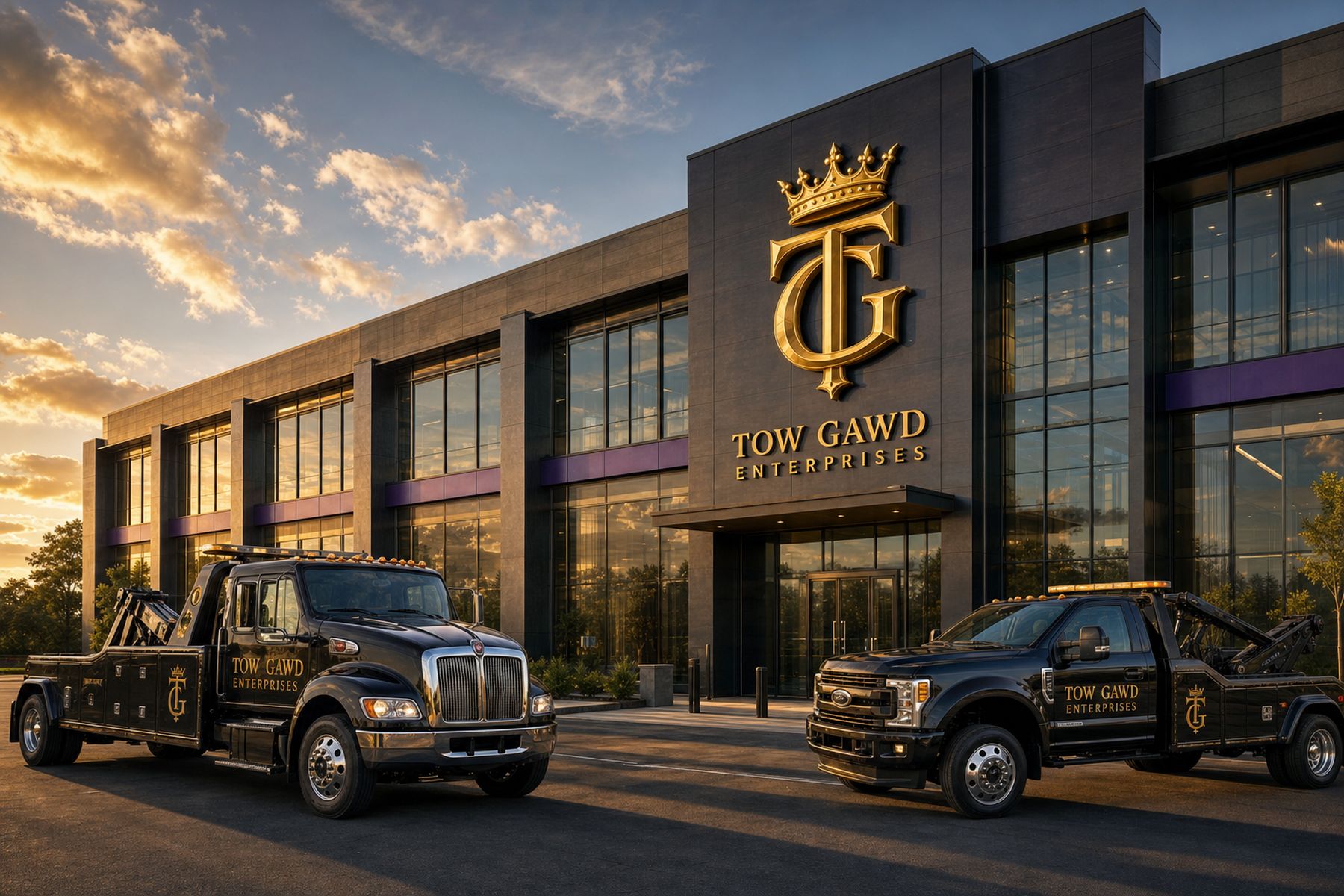
The building on the artwork is the thesis rendered in glass and gold: independence with a physical address.
On the cover of Blemish the Crown he is sitting at a table in front of it — phone to his ear, cigar going, purple velour, trucks in the lot, the crowned crest mounted three storeys up on the facade while crews are still working the site. Nothing about that image is finished. That is the point. It is a man conducting business in front of his own construction.
It is also the cleanest statement of how he actually operates: independent, business-minded, no trend chasing, no borrowed image. Own the masters, own the mark, own the trucks that carry the mark. Build the thing and let people watch it go up. Built different. Delivered. Respected.
The visual world
Purple and gold, and a city that is never generic.
The artwork is its own argument. Gold for the crest and the crown, deep purple for the cloth — Plush purple, the same color as the towing company's signage, which is not a coincidence. Black for everything the gold has to sit on.
And the locations are real, named, specific. Soulard Farmers Market, established 1779, chalk boards advertising half a chicken and three-dollar peaches, a Plush flatbed parked at the curb on South 7th. The Gateway Arch in the gap between buildings. Streetside on Washington. A tow yard at golden hour. Louis, in daylight, at a farmers market, which almost nobody in this lane does.
The videos extend it into narrative. Walk by Faith runs as a long autobiographical sequence. Bittersweet puts the record in an orchard among working lives. Distance plays out present-day and unresolved. Live With Pain walks from a church pew into the trauma and ends in a tidal wave. Cinematic short-film treatments built around the records rather than behind them.
In his own words
Tow Gawd is a Midwest artist creating street gospel for those who've really lived through something. His sound blends trap, R&B, blues, and soul into raw records about late nights, hard lessons, fake love, loyalty, distance, and seeing people for who they truly are. He doesn't make industry-packaged pain or fantasy music — every track comes from real experience and pressure.
His music speaks on toxic cycles, women doubling back when life falls apart, and the clarity that comes after chaos. You hear growth, detachment, and control in every record. Smooth melodies mixed with gritty substance give his sound a balance of emotion and strength without ever sounding weak.
Independent and business-minded, Tow Gawd moves with intention and builds on his own terms. No trend chasing, no fake image — just real life, real stories, and a voice for those leveling up and outgrowing what no longer fits.
The record, on paper
- FromSt. Louis, Missouri
- GenreStreet Gospel
- LaneHip-Hop · R&B / Soul
- LabelPlush Music Group
- DistributionDistroKid — all platforms
- VoiceChest-driven tenor, E3–G3
- Catch phraseTowing and Hoeing
- CreedLoyalty. Pain. Purpose. Legacy.
Start with the front door.
If you only play one record, play One Foot. If you play two, play In It & Not of It after it.